
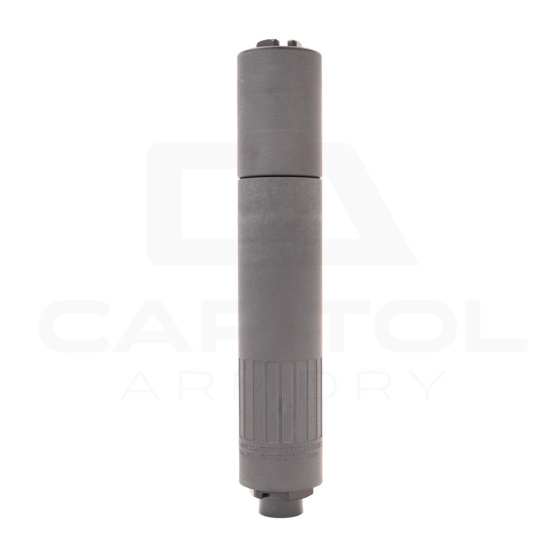
CAT SC/B1
Want to learn more about how easy it is? Read about suppressors direct to your door.

CAT SC B1 MODULAR 9MM TITANIUM SUPPRESSOR - STREET CRACK TWO-PIECE MODULAR PISTOL SILENCER
The CAT SC B1 (Street Crack) is a two-piece modular 9mm titanium suppressor built for shooters who want flexibility without compromise. Run it short at 5.5 inches for a compact, maneuverable package, or extend it to 7.5 inches for maximum suppression on your 9mm semi-automatic handgun. Titanium construction and a Diamond-Like Carbon (DLC) finish deliver serious durability without unnecessary weight, and the included 1/2x28 booster piston keeps your pistol cycling reliably. Optimized for 900 to 1,200 ft/s ammo velocity with no barrel length restrictions, the SC B1 covers the full range of 9mm semi-auto pistol use in one suppressor.
CAPITOL ARMORY'S OPINION
The SC B1, also known as the "Street Crack" earns its place in a crowded 9mm suppressor market by actually solving a real problem. Shooters rarely need the same suppressor configuration in every situation, and most cans force you to pick one length and live with it. The two-piece modular design lets you run it short when you want a tighter package or long when you want every decibel of suppression possible. Switching between the two takes only a few seconds. Titanium construction and a DLC finish give you durability without the weight penalty, and the booster assembly means you're not fighting your pistol for reliable cycling.
The SB-SHOCK design and optimization for the Glock 19 are worth noting for anyone running that platform specifically. The SC B1 is also compatible with CGS pistons, which gives you some mounting flexibility if you're already in that ecosystem. If you shoot a 9mm pistol and want the practical flexibility of two suppressor configurations in one can, the SC B1 is worth serious consideration.
FEATURES
- Two-piece modular construction. 5.5" (short) and 7.5" (long) configurations.
- Caliber: 9mm
- Weight (long): 9.5 oz
- Weight (short): 7.5 oz
- Diameter: 1.40"
- Titanium construction
- Diamond-Like Carbon (DLC) finish
- SB-SHOCK design
- 1/2x28 piston included
- Compatible with CGS pistons
- Optimized for Glock 19
- Optimized ammo velocity: 900 to 1,200 ft/s
- No barrel length restrictions
WHAT'S INCLUDED
- CAT SC B1 Modular 9mm Titanium Suppressor
- 1/2x28 Piston
MEDIA
| Weight | 9.5oz |
|---|---|
| Manufacturer | CAT |
| Caliber | 9mm |
| Length | 7.5 |
| Diameter | 1.405″ |
| Decibel Reduction / Output | Not Provided |
| Full Auto Rated | No |
| Mount | Piston Mounting System / Thread On |
| Thread Pitch | 1/2x28 |
| Color | Black |
| Finish | DLC |
| Materials | Titanium |
| Can Be Disassembled | No |
| Warranty | https://specterscat.com/warranty-and-returns/ |
What's the difference between the CAT SC/B1 and the CAT SC-S?
These two are closely related. They share the same SB-SHOCK technology, the same titanium and DLC construction, and the same 1/2x28 booster piston system. The difference comes down to modularity. The SC/B1 is a two-piece design: run it at 5.5 inches when you want a tight, maneuverable package, or extend it to 7.5 inches when you want maximum suppression. The SC-S, by contrast, is a fixed-length standalone can. It's built around the short configuration that many SC shooters found to be the sweet spot anyway, so CAT trimmed the extra section and refined the end cap design for that length specifically. The SC-S is slightly lighter at 7.5 oz fully configured, and its 2025 Sniper3 end cap squeezes more efficiency out of the shorter gas path. If you already know you want to run compact all the time, the SC-S is the cleaner solution. If you want the flexibility to go long when it matters, the SC/B1 gives you that option without buying a second can.
Can I take the baffles out and clean it?
The SC/B1 is not a user-serviceable suppressor in the traditional sense. The internal geometry is built using DMLS additive manufacturing, which is a 3D printing process that creates baffle structures impossible to produce with conventional machining. Because of that geometry, the internals are not designed to be disassembled for cleaning the way a traditional stacked-baffle can would be. The good news is that 9mm pistol suppressors generally don't need the deep cleaning that rimfire cans require. Running jacketed ammunition keeps fouling manageable, and the two-piece modular design does allow for inspection and solvent soaking of the internals without full disassembly. CAT recommends following their manual for maintenance guidance and avoiding anything that could damage the internal titanium surfaces. For day-to-day use, field cleaning of the booster assembly is the main maintenance task to stay on top of.
How does the piston work?
The SC/B1 uses a Nielsen device, also called a booster assembly, which is standard equipment for running a suppressor on any semi-automatic pistol with a tilting barrel (think Glocks, SIGs, 1911s, most modern striker-fired handguns). When a suppressor is attached to a tilting barrel, the added weight at the muzzle can prevent the barrel from cycling correctly. The Nielsen device solves that by allowing the suppressor to move independently during the recoil cycle, letting the barrel tilt and unlock while the suppressor momentarily stays in place. The SC/B1 ships with a 1/2x28 piston, which covers the vast majority of 9mm handguns. It's also compatible with CGS metric 13.5x1 LH pistons for European-threaded hosts. If you're swapping between multiple pistols with different thread pitches, additional pistons let you make that change quickly without tools. To learn more about how pistol suppressors work, read our article here.
What gun is the SC/B1 best on?
CAT optimized the SC/B1 specifically for the Glock 19, and it's tuned for the 9mm velocity range of 900 to 1,200 ft/s. In practice, that covers the full range of modern 9mm semi-automatic handguns. Full-size and compact pistols with tilting barrels are the primary use case. Glocks, SIG Sauers, Smith & Wesson M&Ps, Walthers, Springfield Armory pistols, FN pistols, and similar platforms all work well. The suppressor's 1.40" diameter keeps the footprint relatively slim for a 9mm can, which helps with holster compatibility and overall balance on a pistol. At 7.5 oz short or 9.5 oz long, it doesn't dramatically upset the balance of a full-size host. Subcompact pistols with very short barrels can also work. There's no minimum barrel length restriction. The SC/B1 is optimized for semi-automatic use, and while it can run on compatible subgun platforms with the right mounting setup, if your primary use case is a PCC or SMG, the CAT MOB is purpose-built for that role.
Can I use it on my rifle?
Yes and no, but it's really designed for traditional pistol use. If you're running a 9mm pistol-caliber carbine like an AR9, CZ Scorpion, HK SP5, or similar platform, the SC/B1 can work on those hosts with appropriate fixed-barrel mounting hardware. You'll need to replace the spring in the booster assembly with a fixed barrel spacer, since PCCs and subguns use fixed barrels that don't require a Nielsen device. What the SC/B1 is not designed for is centerfire rifle calibers. It's a 9mm pistol suppressor and using it on anything chambered in .223, 5.56, .308, or similar is not an appropriate application. If you're looking to suppress a rifle-caliber platform, CAT makes rifle suppressors purpose-built for that.
What is SB-SHOCK?
SB-SHOCK is CAT's internal gas management technology used in the SC series. It's a hybrid approach that blends characteristics from two of CAT's other proprietary systems, Surge Bypass and DiVerge, to optimize the SC specifically for pistol use. At its core, SB-SHOCK uses an internal lattice structure created through the DMLS additive manufacturing process to control how gas flows through the suppressor after firing. The goal is twofold: maximize sound reduction at the muzzle and at the shooter's ear, while simultaneously keeping backpressure and gas blowback as low as possible. That low-backpressure behavior is meaningful for pistol shooters because it means less gas coming back through the action toward your face, cleaner cycling across a wide range of ammunition without needing to tune recoil springs, and better consistency across subsonic and standard-velocity loads. PEW Science testing of the SC showed a suppression rating that placed it among the best-performing 9mm pistol suppressors currently on the market, with notably low first round pop which is often a common weak spot for titanium pistol cans. SB-SHOCK is also what allows the SC/B1 to run reliably across a wide variety of 9mm pistol platforms without requiring host-specific tuning.
CAT seems like a weird company. What's their deal?
CAT, short for Combat Application Technologies, is a legitimate head-scratcher if you're used to the more buttoned-up brands in the suppressor world. The brand names alone (Street Crack, Dirty Dave, Kitty Kat, White Bread) signal pretty quickly that they're not trying to look like every other defense company. And that's intentional. CAT emerged from a global R&D group focused on Special Mission Unit programs. The kind of organization that doesn't put out press releases very often. Their suppressors were originally developed for military direct action programs, not the commercial market, and CAT's entry into the U.S. civilian and law enforcement market came through a partnership with CGS Group, who handles U.S. distribution. The manufacturing is built around DMLS additive manufacturing, industrial 3D printing in titanium and Inconel, which lets CAT create internal baffle geometries that are simply not possible with traditional CNC machining. That's the actual origin of their performance advantage. It's a manufacturing process that produces different results. The brand aesthetic with quirky names and unconventional marketing is deliberate. CAT's own people have described it as "a touch naughty" and "a pleasant departure." Behind the personality is serious engineering with documented performance data from independent sources like PEW Science. They're a real company making real suppressors with an unusual origin story and a sense of humor about it.
How does the SC/B1 compare to the Obsidian 9 or Mojave 9?
These three are all strong competitors in the modular 9mm pistol suppressor space, but they approach the problem differently. The Rugged Obsidian 9 is the most conventional of the three. It uses a machined 17-4 stainless steel baffle stack in an anodized aluminum tube, which makes it easy to disassemble and clean. It runs full length at 7.8" or drops to 4.85" in the short ADAPT configuration, and at 1.37" diameter it clears most suppressor-height sights right out of the box. It's also Belt Fed Rated and carries Rugged's unconditional lifetime warranty, which is one of the best in the industry. The tradeoff is that it's heavier. 12.7 oz full length versus the SC/B1's 9.5 oz, and the traditional baffle design produces more backpressure than the additive-manufactured designs. The Dead Air Mojave 9 is closer to the SC/B1 in philosophy. It also uses DMLS additive manufacturing with a 3D-printed titanium Triskelion baffle structure, and ultra-low backpressure is the centerpiece of its design. It runs short at 5.89" and 8.2 oz, or full at 7.64" and 9.6 oz. The Mojave 9's P-Series booster system is a notable feature. It uses a swappable design that makes host changes quick and tool-free, and it's compatible with Dead Air's broader P-Series ecosystem. The CAT SC/B1 splits the difference in some ways: it's the lightest of the three at 7.5 oz short, and its SB-SHOCK technology is specifically tuned for 9mm pistol use. Where it gives ground is in serviceability. The DMLS interior isn't a baffle stack you can pull out and scrub, and the ecosystem is smaller. If you're already running Dead Air or Rugged mounting hardware across other suppressors, there's real value in staying in that ecosystem. If you're starting fresh and want the most advanced internal technology in the lightest possible package, the SC/B1 earns serious consideration.