
4473 vs. Form 4 Suppressors: What to Know Before You Choose
On October 9, 2026, ATF announced it will no longer require ATF approval or registration for suppressors (silencers), and that the policy applies to anyone (ATF open letter). In states where state law allows it, you can now take home a suppressor on a Form 4473 alone, with no Form 4. We offer that option. We also still offer the Form 4. Where both are available, the choice is yours.
We'll give you the facts and tell you where we stand: for most buyers, the short-term gain of a 4473 suppressor doesn't outweigh the long-term benefits of a Form 4. A 4473 suppressor comes with asterisks, and some of them can make it disposable. Here's why.
The biggest asterisk is that this isn't permanent. ATF's own guidance says enforcement could resume (ATF guidance). A new administration, a different ATF or Justice Department, or a single court ruling could change the rules. A Form 4 suppressor is registered, so it complies with the NFA no matter who's enforcing it. A 4473 suppressor depends on today's policy.
Why we recommend a Form 4
A Form 4 takes a little more paperwork up front. In return, the suppressor is registered to you or your trust, so it complies with the NFA no matter who's enforcing it.
- It's yours for life. You register once, there's nothing to renew, and the federal tax is $0.
- Approvals come back in days. ATF's August 2026 averages were 6 days for individual eForm 4s and 20 days for trusts (ATF).
- You can share it. On an NFA trust, the trustees you name can possess and use the suppressor under the trust's terms.
- You can travel with it. A registered suppressor doesn't need ATF approval to cross state lines. You still follow the laws of every state you enter.
- Resale and inheritance have a clear path. A sale goes to the next owner on a Form 4, and an heir gets it on a tax-exempt Form 5.
- Future orders require just a signature. We keep your prints and photo on file.
If this is your first suppressor, our step-by-step guide covers the whole process.
How to buy a suppressor from us today
Form 4, shipped to your home
Our recommendation. We ship to your door in all 42 states where suppressors are legal to own. Here's how it works.
Form 4 or 4473, picked up at our store
Texas only for now, at our Cedar Park store. Pickup in more states is coming in the next few weeks.
4473, shipped to your home
Where state law allows it, you can choose 4473 home delivery. SBRs, SBSs, and AOWs can use the same 4473 delivery option. See our 4473 ship-to-home page for who qualifies and how it works.
Shipped to your dealer
If we can't offer a 4473 suppressor in your state yet, we can send it to the dealer of your choice.
You'll choose at checkout. Right after you review your cart, you choose how you want the suppressor delivered: to your door, to our store, or to your dealer, on a Form 4 or, where it's available, a 4473.
Was the NFA repealed? No.
No. A court ruling and a change in ATF policy changed how the law is enforced, but the National Firearms Act is still on the books. Here's what each one did.
What the court did. On August 5, 2026, a federal court in Texas issued an injunction in Silencer Shop Foundation v. ATF. The NFA was written as a tax law, and its registration rules existed to collect that tax. Once Congress set the suppressor tax at $0, there was nothing left to collect, so the court ruled those rules can't stand on Congress's power to tax.
What ATF did. On October 9, 2026, ATF announced it will no longer require ATF approval before making or transferring a suppressor, or require suppressors to be registered in the National Firearms Registration and Transfer Record. The policy applies to everyone. The same policy covers short-barreled rifles, short-barreled shotguns, and AOWs. The Justice Department describes it as using its "enforcement discretion" (ATF open letter). ATF also says it "will not enforce § 5861(j) as applied to unregistered NFA items." That's the section that makes it a crime to move an unregistered NFA firearm across state lines (ATF guidance).
What didn't change.
- Neither one repealed the NFA. The registration requirement is still federal law. ATF has chosen not to enforce it, and that choice can be reversed.
- A court order and an ATF policy aren't law. Neither one changed the NFA. You're relying on the current ATF and administration's policy, and that can change (details below).
- The felony is still on the books. A suppressor bought on a 4473 without a Form 4 isn't registered. ATF's own FAQ says people who make, possess, transfer, or receive unregistered NFA firearms "are subject to felony penalties and forfeitures" (ATF FAQ). ATF isn't enforcing that today. If a future administration rescinds the guidelines, enforcement can resume.
All of this can change
ATF says it plainly: "Material changes in legal or factual circumstances could cause NFA enforcement to resume." It lists three ways that could happen: Congress could impose a new tax on NFA firearms, the August 5 injunction could be dissolved or overturned, or the Justice Department could rescind its enforcement guidelines (ATF guidance).
Rescinding the guidelines doesn't take a vote in Congress or a court ruling. A new administration, attorney general, or ATF director could decide to enforce the law again.
A new tax takes one act of Congress, at any amount. Congress cut the suppressor tax to $0, effective January 1, 2026, and the bill passed the House by four votes, 218 to 214. It took a simple majority to cut the tax, and a simple majority can put one back. A change in control of the House could be all it takes. The August 5 injunction only reaches untaxed NFA firearms, and ATF's policy "only extends to firearms on which Congress eliminated the making and transfer taxes" (ATF guidance). Put any tax back on suppressors, and both may stop applying.
If enforcement resumes, a registered suppressor is already compliant. A 4473 suppressor is still an unregistered NFA firearm. ATF says federal law "does not generally permit subsequent registration of unregistered NFA items." The NFA lets the Attorney General hold an amnesty of up to 90 days, but ATF adds that the Attorney General "is not required, however, to hold an amnesty or to provide forbearance" (ATF guidance). The last NFA amnesty, in 1968, ran 30 days (NFA Handbook § 3.2.1).
ATF Still Calls Unregistered NFA Firearms Contraband
From ATF's FAQ
"The NFA treats unregistered firearms as contraband."
ATF, "What are the legal risks of making, possessing, or transferring $0-tax firearms?"
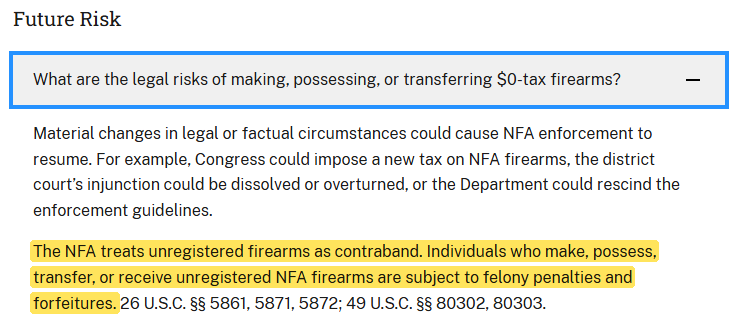
That's ATF's own wording. Today, ATF isn't enforcing the NFA's registration rules against suppressors. If that changes, ATF says there are no provisions that would automatically grandfather unregistered NFA firearms, and an amnesty is up to the Attorney General. A suppressor on an approved Form 4 is registered, so none of this applies to it.
The question isn't whether a 4473 suppressor is legal to buy today. It's whether you want to own one if the rules change.
What you give up with a 4473 suppressor
A 4473 suppressor comes with an asterisk built in. Some of those limits can turn it into a disposable suppressor: one you may not be able to fix, sell, move, or pass on.
The speed gap is smaller than it looks
A 4473 suppressor goes home the same day only if it's in stock and the background check comes back Proceed. Many dealers don't keep a large inventory like we do. They rely on an in-store kiosk, and the suppressor can take 1 to 2 weeks just to arrive. A Delayed response adds time. Some states add a waiting period on top of that. Florida's, for example, is 3 days, excluding weekends and holidays, unless you hold a concealed weapons license.
The Form 4 is now voluntary, and it's faster than it used to be. ATF says it will keep accepting Form 4s to transfer or register suppressors (ATF open letter). We've seen single-trustee trust approvals come back in as little as a day when the FBI check is an automatic Proceed. ATF's August averages were 6 days for individual eForm 4s and 20 days for trusts (ATF approval times). See our current Form 4 wait times. The federal transfer tax on suppressors is $0. You register once, there's nothing to renew, and registration keeps it compliant today and under future administrations.
We keep your prints and photo on file, so future orders require just a signature.
If it's your first time, our step-by-step guide covers the whole process, including at-home fingerprinting. If you want a trust, ours is set up online and signed digitally, with no notary visits.
Sharing it depends on today's policy
A 4473 suppressor goes to you as an individual.
Under the NFA, a "transfer" includes loaning it (26 U.S.C. § 5845(j)). ATF now says individuals don't need its approval before making or transferring these items (ATF guidance). So today, ATF isn't requiring approval when your spouse or adult son takes it hunting without you. If enforcement resumes, that loan could be an unapproved transfer again.
A Form 4 to a trust avoids this. The trustees you name can possess and use the suppressor under the trust's terms.
A trust also lets you pass your suppressors to your kids and grandkids without probate (our NFA trust). Trusts have always been, and still are, the way to keep these items in your family for generations. Deciding between a trust and filing as an individual? See trust vs. individual filing.
Crossing state lines depends on today's policy
A registered suppressor doesn't need ATF approval to cross state lines. You still follow the laws of every state you enter.
A 4473 suppressor isn't registered to you. Federal law makes it a crime to transport, deliver, or receive an unregistered NFA firearm in interstate commerce (26 U.S.C. § 5861(j)). ATF now says it "will not enforce § 5861(j) as applied to unregistered NFA items" (ATF guidance). That's a policy, not a change in the law. If ATF starts enforcing it again, taking a 4473 suppressor across a state line could be a federal crime.
State laws still apply. ATF says "individuals should exercise caution before transporting unregistered NFA items through states" and should check state and local law first (ATF open letter). That matters most in the 14 states that allow suppressors only with NFA compliance, listed below.
That covers out-of-state hunts, matches, and moving. If you relocate, you also take on your new state's law, and some states tie suppressor possession to federal registration.
Do you want to be the test case?
Plenty of laws are written around a registered suppressor. Ohio, for example, makes possessing a suppressor a felony unless it's registered in the federal registry (Ohio Rev. Code § 2923.17). Some hunting regulations do the same. If a hunting regulation requires your suppressor to be registered, a 4473 suppressor leaves you out of luck.
If a game warden or prosecutor reads "registered" literally, a 4473 suppressor could leave you arguing in court that a federal policy satisfies state law. You might win, but you'd still have to make that argument and pay for it.
Repairs and warranty: assume Form 4 only
ATF's new guidance addresses shipping a suppressor to a manufacturer for repair. It says that, as a matter of enforcement discretion, ATF isn't enforcing § 5861(j) against unregistered NFA items (ATF guidance). That protection lasts only as long as the policy does.
Manufacturers are handling this differently. We're aware of at least one manufacturer that isn't warranting 4473 suppressors. SilencerCo says its warranty still covers suppressors transferred on a 4473, but you can't ship one back to them, and its warranty team contacts you about next steps (SilencerCo warranty). Until your manufacturer gives specific guidance on 4473 suppressor warranties, assume the warranty only covers Form 4 suppressors. A suppressor no one will fix is a disposable suppressor.
There's no "register it later"
If you buy on a 4473 and change your mind later, there is no established path to register it. ATF says federal law "does not generally permit subsequent registration of unregistered NFA items" (ATF guidance). ATF's NFA Handbook also says ATF won't approve a transfer unless the firearm is registered to the person transferring it.
Selling it is easier today, since ATF isn't requiring approval for transfers. But your buyer takes on the same asterisk, and a dealer may not want to take it in trade.
Passing it on has no clear path
A registered suppressor passes to an heir on a tax-exempt Form 5. ATF finalized eForm 5s in an average of 1 day in August 2026 (ATF). A suppressor held in a trust can stay with the trust when a trustee dies.
ATF's new guidance doesn't address inheritance. ATF's NFA Handbook treats an NFA firearm that wasn't registered to the person who died as contraband that can't go through the normal estate process. If enforcement has resumed by the time your estate is settled, that's the rule your heirs could face. There's still no established way to pass a 4473 suppressor on to future generations.
Your proof is a policy, not a form
An approved Form 4 shows the suppressor is registered to you, and federal law requires you to keep that proof (26 U.S.C. § 5841(e)).
With a 4473 suppressor, there's no registration to show. If an officer in another state, an insurer, or your executor asks, your answer is ATF's current enforcement policy, and that can change.
State law is a separate question
Some states' suppressor laws point to federal registration or NFA compliance. A Form 4 suppressor satisfies that. Whether a 4473 suppressor does depends on the wording of each statute. ATF's guidance doesn't change state law (ATF open letter).
States can also change their laws. If yours adds an NFA registration requirement, a registered suppressor already complies.
4473 vs. Form 4 at a glance
A 4473 has the advantage on speed and paperwork. A Form 4 has the advantage on most of what happens after you take it home. Each row is explained, with sources, above.
| Topic | 4473 only | Form 4 |
|---|---|---|
| Time to take home | Same day, if it's in stock at your dealer and the background check says Proceed. Ordered through a dealer's kiosk, it can take 1 to 2 weeks just to arrive. A Delayed adds time, and some states add a waiting period, like Florida's 3 days (waived for concealed weapons license holders). | Trusts in as little as a day on an automatic Proceed. ATF averages: 6 days individual, 20 days trust (August 2026). |
| Paperwork | 4473 and background check. Shipped home: a carry permit from your home state, for now. | Form 4 with prints and photo. We keep both on file, so future orders require just a signature. |
| Who can buy | Individuals | Individuals, trusts, and LLCs |
| Where | 28 states at most. We ship to your home in 19. | All 42 states where suppressors are legal |
| Legal footing | Not enforced by ATF, for now. The law still stands. | Complies with the NFA as written |
| If enforcement resumes | Generally can't be registered later. An amnesty is up to the Attorney General. | Already registered |
| Upkeep | Nothing to file. Your status depends on ATF's current policy. | Nothing to maintain or file annually. $0 tax. |
| Proof of ownership | No registration. ATF's current policy is your answer. | Approved Form 4 |
| Sharing | ATF isn't requiring approval for transfers today. That can change. | Trustees can possess it under the trust |
| Travel | ATF isn't enforcing § 5861(j) for now. State laws still apply. | No ATF approval needed. Follow each state's law. |
| Moving | Depends on ATF's policy and your new state's law | Move to any suppressor-legal state |
| Laws that require registration | You may be the test case | Meets them |
| Repairs and warranty | Assume no warranty until your manufacturer says otherwise. At least one won't repair them. | Covered by ATF's repair letter |
| Selling or trading | No ATF approval needed today. Your buyer takes on the asterisk. | Form 4 to the next owner |
| Estate planning | No established path to pass it on to future generations | Tax-exempt Form 5, or the trust carries on |
| Registry | Not registered to you | Registered to you or your trust, as a confidential tax record |
| What's unsettled | How long ATF's policy lasts, and what happens if it ends | Established process |
Where the 4473 comes out ahead
- No fingerprints or photo
- No wait for ATF approval
- The suppressor isn't registered to you in the NFRTR
A 4473 may fit you if
- You're comfortable owning it if ATF's policy changes
- You won't take it into states that require NFA compliance
- You accept the open questions on repairs, resale, trusts, and inheritance
- Staying off the registry matters more to you than the items above
Which path fits you?
If any answer is yes, we recommend a Form 4
Our recommendation, based on the trade-offs in this article
Will anyone else use it, or will a trust own it?
Spouse, adult child, hunting partner
Will it ever leave your state?
Out-of-state hunts, matches, a move, repairs
Might you sell it or leave it to family?
Trade-in, private sale, estate
Is a 4473 offered in your state?
19 states now, up to 28 allowed
Form 4
- Registered to you or your trust
- Shareable through a trust
- Travel, repair, resale, Form 5
Recommended for most buyers
A 4473 is an option
It depends on ATF's current policy
Form 4 or your dealer
We ship to the dealer you choose
If any of the first three answers is yes, the Form 4 is the safer route. A 4473 only makes sense when all three are no and it's offered in your state.
Which states allow a 4473 suppressor?
It depends on your state's law. Suppressors are legal in 42 states. In 14 of them, state law ties a legal suppressor to NFA compliance, so a 4473 suppressor isn't an option there. That leaves 28 states where a 4473 suppressor is possible under today's policy. Click your state to see how we ship suppressors there.
Allowed on a 4473 or a Form 4: 28 states
State law allows suppressors without tying them to NFA registration. A 4473 suppressor is possible here under today's policy. We ship 4473 suppressors to your home in 19 of these states. See which 19 →
Alabama, Arizona, Arkansas, Florida, Idaho, Indiana, Iowa, Kansas, Kentucky, Louisiana, Maine, Maryland, Minnesota, Mississippi, Missouri, Nebraska, New Hampshire, New Mexico, Oklahoma, South Carolina, South Dakota, Tennessee, Texas, Utah, Vermont, Virginia, West Virginia, and Wyoming
Tied to registration, Form 4 only: 14 states
Suppressors are legal only with NFA compliance, so a 4473 suppressor isn't an option. On a Form 4, we ship to your door.
Alaska, Colorado, Connecticut, Georgia, Michigan, Montana, Nevada, North Carolina, North Dakota, Ohio, Oregon, Pennsylvania, Washington, and Wisconsin
Prohibited: 8 states and Washington, D.C.
Suppressors are prohibited outright, Form 4 or not.
California, Delaware, Hawaii, Illinois, Massachusetts, New Jersey, New York, Rhode Island, and Washington, D.C.
ATF's new policy doesn't change state law, and states can change theirs. See suppressor laws for every state.
The NFA registry isn't what most people picture
Nobody likes being on a federal list. But we've never heard of a case where registering a suppressor brought a knock on someone's door. The registry isn't what many people assume it is.
The NFRTR sits in the tax code, not in a gun registry the way most people imagine one. NFA forms are treated as tax returns, and registration information as tax return information. Under 26 U.S.C. § 6103, ATF is generally prohibited from disclosing it. ATF won't even confirm your registration status over the phone.
And federal law limits how your registration can be used. Information from your NFA application or registration can't be used as evidence against you in a criminal case for a violation that happened before or when you filed, unless you filed false information.
The bottom line
A 4473 suppressor gets you out the door faster. ATF's own words are worth reading. "The NFA treats unregistered firearms as contraband," and people who possess them "are subject to felony penalties and forfeitures" (ATF FAQ). A suppressor transferred to you on a 4473 without a Form 4 is not registered to you in the NFRTR.
Today, ATF has chosen not to enforce those provisions. That's an enforcement policy, not a change in the law, and ATF says the policy could end. If enforcement resumes without a grandfathering provision, amnesty, or other relief, you could be left possessing an NFA firearm that isn't registered to you, with no established way to register it after the fact. ATF says federal law does not generally permit subsequent registration and does not automatically grandfather unregistered NFA firearms. A violation of the NFA can carry up to 10 years in federal prison (26 U.S.C. § 5871). Would anyone actually be charged if the policy changes? No one can promise you either way.
There is also no clear answer on how a return to enforcement would happen. ATF's guidance doesn't say what notice, transition period, or relief owners would receive if the policy is rescinded.
Depending on what changes, you may also lose the ability to take it out of state, get it repaired, sell it through an established process, or reliably leave it to your family. A registered suppressor doesn't depend on ATF continuing this policy. That's why we recommend a Form 4 for most buyers.
If you already own a registered suppressor, you're on the registry either way. Skipping it on the next one doesn't take you off. It just leaves you with one suppressor that plays by different rules than the rest. And don't unregister the ones you have. ATF says once an item is removed, "it cannot be re-registered unless the Attorney General declares an amnesty" (ATF guidance).
With a $0 tax, approvals in days, and future orders that require just a signature, we think the Form 4 is the better choice for most buyers. If a 4473 fits your situation, we'll do it. If you want to talk it through, call us at (512) 879-1068.
Suppressor questions we hear most
Can you buy a suppressor without a Form 4 now?
Yes, on a 4473, if you live in one of the 28 states that allow it. Since October 9, 2026, ATF says it won't require approval or registration for suppressors (ATF open letter). You still fill out a 4473 and pass a background check. We offer 4473 delivery where state law allows it. That's ATF's policy today, and it can change.
Can I buy a suppressor without a Form 4 in my state?
It depends on your state's law. In 28 states, including Texas, Florida, and Virginia, state law allows a 4473 suppressor. In 14 states, including Ohio, Pennsylvania, Georgia, North Carolina, and Michigan, state law ties a legal suppressor to NFA compliance, so you'll need a Form 4. See the full state lists above.
Do you still need a Form 4 for a suppressor?
Not under ATF's current policy, in states that allow it. The Form 4 is now voluntary, and ATF still accepts them. We recommend it for most buyers. If you're buying through a trust, use a Form 4.
What is a Form 4?
ATF Form 4 is the application to transfer an NFA item, like a suppressor, and register it to you or your trust. Once ATF approves it, the suppressor is registered in the National Firearms Registration and Transfer Record. ATF still accepts Form 4s under its October 9 policy (ATF open letter). When you buy from us, we prepare yours, and you e-sign and certify it.
What is a 4473?
ATF Form 4473 is the Firearms Transaction Record you fill out when you buy a firearm from a dealer. ATF says dealers must complete one before transferring a suppressor to an unlicensed buyer (ATF FAQ). A 4473 suppressor is one transferred on that form alone, with no Form 4, so it isn't registered to you under the NFA.
Can you buy an SBR, SBS, or AOW on a 4473?
Yes. ATF's October 9 policy also covers short-barreled rifles, short-barreled shotguns, and AOWs. Where state law allows it, we can ship them to your home on a 4473. SBRs and SBSs still need an approved Form 5320.20 before crossing state lines, registered or not (ATF FAQ). We still recommend a Form 4. Details on our 4473 ship-to-home page.
Is the suppressor tax stamp free now?
Yes. The federal transfer tax on suppressors has been $0 since January 1, 2026. If you file a Form 4, registration keeps your suppressor compliant today and under future administrations. More on the $0 tax stamp.
Was the NFA repealed?
No. A federal court issued an injunction on August 5, 2026, and ATF has since chosen not to enforce the approval and registration rules for suppressors. But a court order and an ATF policy aren't law. The NFA itself is still federal law, and ATF says enforcement could resume. See our NFA ruling update.
Can ATF start enforcing the NFA again?
Yes. ATF says enforcement could resume if Congress imposes a new tax, the August 5 injunction is dissolved or overturned, or the Justice Department rescinds its guidelines. If that happens, federal law doesn't generally allow registering a suppressor after the fact (ATF guidance).
How long are Form 4 wait times?
ATF's August 2026 averages were 6 days for individual eForm 4s and 20 days for trusts (ATF). See our current approval times.
Can a suppressor be shipped to my house?
Yes. We ship Form 4 suppressors to your door in all 42 states where they're legal. Where available, 4473 suppressors can ship to your home. If we can't ship to your door in your state, we can ship to a local dealer you choose. You pick that option at checkout. Details on our 4473 ship-to-home page.
Can I move a 4473 suppressor into a trust or register it later?
There is no established path today. ATF says federal law doesn't generally permit registering an NFA item after the fact (ATF guidance). If you might want a trust, buy on a Form 4.
Ready to Buy on a Form 4?
Every Form 4 purchase includes electronic filing, and your suppressor ships from our facility to your home. If you need a trust or fingerprints, we handle those too. You can also upload an existing EFT file directly to our site.